InvestNext Wins 2026 Investment Management Platform of the Year
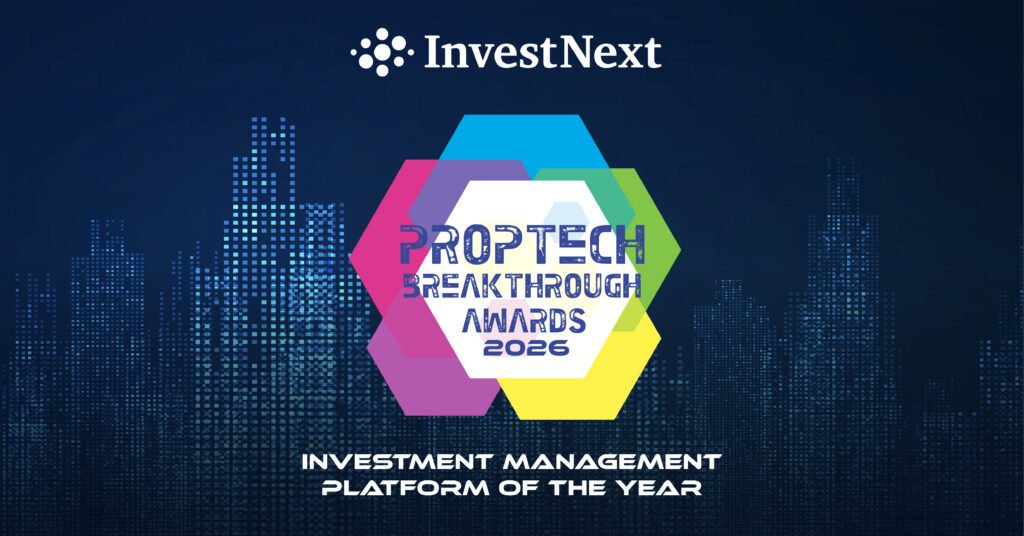
For the second consecutive year, InvestNext has been named Investment Management Platform of the Year by the PropTech Breakthrough Awards.
Winning once is meaningful. Winning two years in a row gives you a reason to reflect.
In particular, the word breakthrough has stuck with me.
What does it actually mean to break through in our industry?
The obvious answer for a software company is innovation: build more features, adopt new technology faster, give clients more capabilities.
But I don’t think that’s the answer.
For us, breaking through has increasingly meant questioning something much more fundamental about software itself:
Why does technology require so much work from the people it’s supposed to help?
Log in. Navigate to the right dashboard. Download the report. Reconcile the data. Open another system. Learn another workflow. Ask the question in exactly the right way.
For years, we’ve accepted this as the cost of using technology.
I think that’s backwards.
The best technology shouldn’t demand more attention from the people using it. It should require less.
And in real estate investing, that distinction matters more than most people realize.
We’ve confused more software with better software
Private real estate has undergone a significant technology transformation over the last decade. Processes that once lived in spreadsheets, filing cabinets, inboxes, and disconnected accounting systems have increasingly moved online.
That’s progress. But digitizing a process doesn’t necessarily improve it.
Too often, our industry has taken an inefficient workflow and simply given it a login.
A GP wants to understand what’s happening across their portfolio, so they log into a platform, navigate across dashboards, download reports, and piece together an answer.
They’re ready to accept capital from investors, but first they need to leave their investment management platform, work with a bank, open the appropriate accounts, wait for approvals, and eventually reconcile incoming wires back to their cap table.
They want to use AI to interrogate their own data, so their software provider gives them another proprietary interface to learn, along with instructions for what they can ask and how they should ask it.
Each individual step might technically “work.”
But zoom out and ask a different question:
Why is the operator doing so much work on behalf of the software?
That question is central to how InvestNext is trying to break through our industry.
Not by adding more software to the operator’s day, but by removing work from it.
Software should fit the operator — not the other way around
When we started InvestNext, we held a simple belief: the GP is the hero of the investor relationship.
Technology is not.
Our job is to support that relationship by handling what can be handled, surfacing what matters, and giving sponsors more capacity for the things only they can do well.
That philosophy leads to a very different product question.
Instead of asking, What else can we add to the platform?
We ask, What can we remove from the operator’s day?
The difference sounds subtle. But in practice, it changes what you build.
Consider moving investor capital.
Historically, accepting capital has required sponsors to cross boundaries between investment management software and banking infrastructure. At exactly the point when investor momentum matters most, the workflow fragments.
So we built InvestNext Transact.
Sponsors can open a business account from within InvestNext in as little as one business day. Incoming wires can automatically reconcile to the cap table. ACH fees are eliminated.
Those capabilities matter. But the larger idea matters more.
The breakthrough isn’t another banking feature. It’s removing the boundary between two workflows that never should have been separate for the operator in the first place.
I believe we’ll see much more of this across financial technology in the years ahead.
The winning platforms won’t simply become bigger destinations. They will make it increasingly unnecessary for users to think about where one system ends and another begins.
AI makes this philosophy even more important
Artificial intelligence is creating a similar inflection point.
Right now, nearly every software company is trying to figure out its “AI strategy.” The default response has been predictable: build an AI assistant inside the product.
There’s nothing inherently wrong with that approach. But I think it starts with the wrong question.
If your customers are already working in leading AI systems every day, why should they have to come back to your software to use AI?
Why should they learn your prompt structure?
Why should they be limited to the questions your interface anticipated?
Why should every software company try to recreate the intelligence layer independently?
We took a different approach.
Through InvestNext’s Model Context Protocol integration, a GP can connect InvestNext with Claude and ask questions about their portfolio, investors, or fund performance using natural language.
The important part, again, isn’t the feature.
It’s the shift in where the interaction happens.
Instead of forcing the GP to come to InvestNext to find the answer, InvestNext can bring the relevant context to the environment where the GP is already working.
Today, that might mean asking an AI system a question instead of navigating through several reports.
Tomorrow, it could mean software anticipating a reconciliation issue before someone goes looking for it, surfacing an investor who needs attention, or completing an operational workflow without requiring someone to orchestrate every step.
That future changes the role of software.
For decades, software has been a destination. Increasingly, I believe it will become infrastructure.
Breakthroughs are built on boring things
There is an important caveat to all of this.
Software can only disappear into the background when you trust what’s happening underneath it.
That is particularly true when investor money and financial data are involved.
An AI-generated answer is only useful if the underlying portfolio data is accurate. Automatic reconciliation only works if the cap table is reliable. A streamlined investor experience only matters if the distribution calculations, accreditation workflows, tax documents, and ownership records behind it are correct.
That’s why some of the least visible work in technology is often the most important.
At InvestNext, the ability to build these newer experiences rests on a decade of infrastructure: waterfall distribution logic, K-1 dissemination, investor onboarding, accreditation verification, cap table management, and the systems supporting more than $200 billion in assets under administration.
None of that sounds particularly “breakthrough” on the surface, compared to the recent leaps we’ve seen in AI innovation.
But that’s precisely the point.
The breakthroughs people see are often only possible because of years spent building the things they don’t.
And I think this distinction is going to become increasingly important as AI makes software easier to build.
When anyone can create an impressive interface, the competitive advantage moves underneath it.
The question becomes less about what your software can show and more about what your infrastructure can reliably do.
The future of software may be less software
Being named Investment Management Platform of the Year for the second consecutive year is an honor, and I’m proud of the team that earned it.
But more than anything, it reinforces what we believe a breakthrough should look like.
Not another feature for the sake of having another feature.
Not another dashboard asking for your attention.
Not another workflow the operator has to learn.
A meaningful breakthrough should make something that used to be difficult feel almost invisible.
For years, software companies competed for engagement. More logins. More time in the platform. More features used.
But those may not be the metrics that define the best software of the next decade.
Maybe the better measure is how much work disappeared.
How many steps no longer needed to happen.
How many questions were answered without opening a report.
How many systems an operator no longer had to move between.
How much more time a GP had to spend talking with investors, evaluating opportunities, and building their business.
Private real estate doesn’t need more technology competing for the operator’s attention.
It needs technology that understands when to get out of the way.
To me, that’s what it means to break through.
Winning this award two years in a row is meaningful validation that we’re on the right path.
But the work is making sure we keep earning it.