For raising capital—and what comes next.
There’s a common assumption built into how firms think about their capital raise tooling: that the hard part is the raise itself, and once investors are in and capital is received, the infrastructure problem is solved.
In practice, that’s when the infrastructure problem starts showing up.
The systems that support the financial side of a capital raise don’t stop being relevant when the first close happens. They shape how distributions are calculated and delivered. They determine how accurately capital movements are tracked against the cap table over time. They influence how much manual work lands on the finance team every quarter. And they define whether your investor relations team has time to invest in managing relationships, or if they’re stuck managing reconciliation.
Many sponsors don’t have a single, connected system. They have a raise platform, a bank, a spreadsheet, and a distribution process someone built on institutional memory.
That fragmentation has a cost. It’s just not a cost that shows up on a single line item.
The fragmentation is structural, not accidental
When firms evaluate software for capital raising, they’re usually solving a specific problem in front of them: investor management, cap table tracking, document management, communications. Each tool gets selected on its own merits.
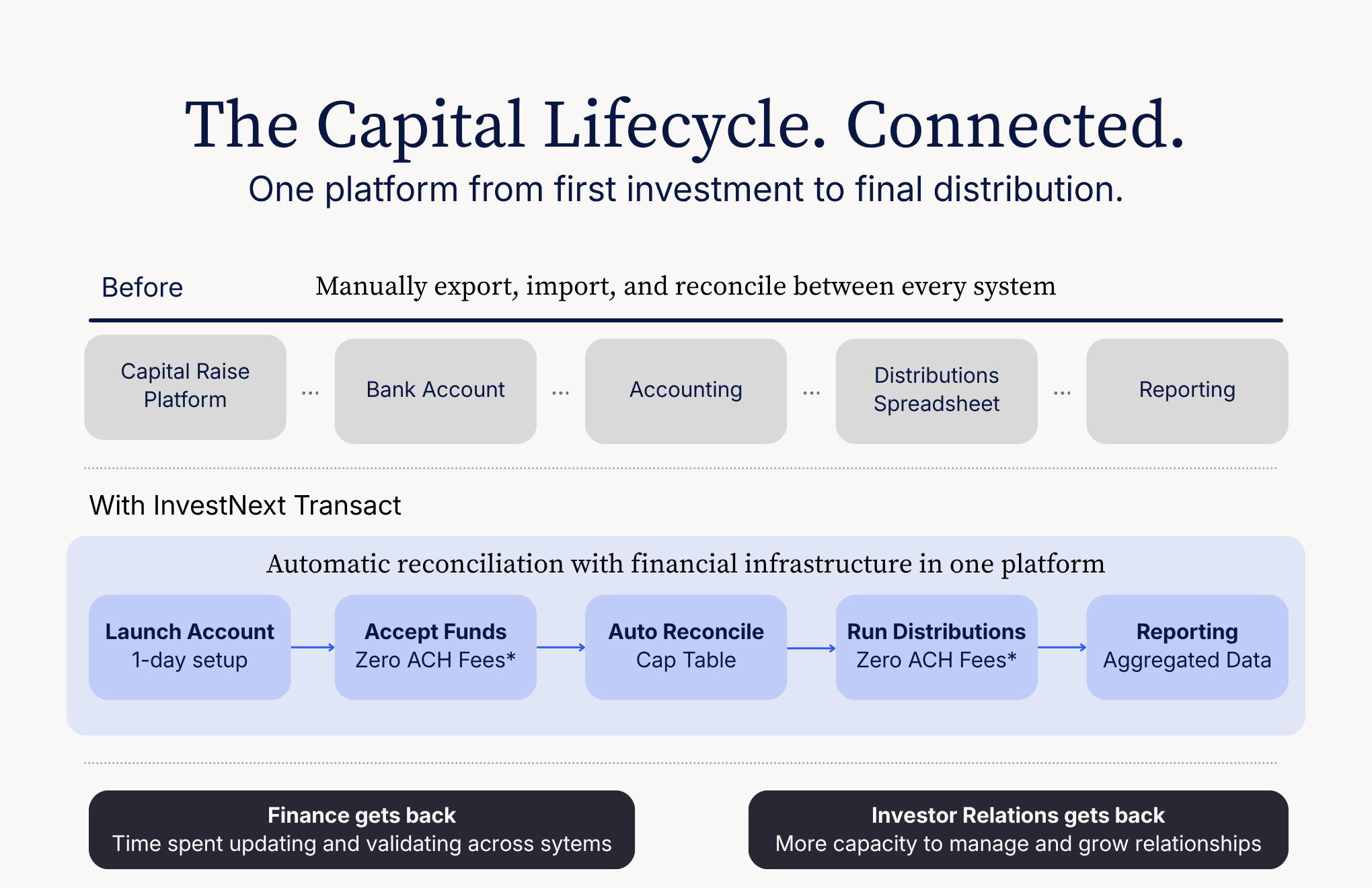
What results is a financial stack that requires significant human effort to work as a whole. The raise platform knows who committed and how much. The bank knows what arrived and when. The accounting system knows what was distributed and to whom. And somewhere between all three, a person is maintaining the connective tissue—exporting, importing, reconciling, confirming, correcting.
InvestNext, Inc. is a software company, not an FDIC-insured banking institution. Banking services are provided by Grasshopper Bank, N.A., Member FDIC.
Where the gaps actually surface
- Capital intake and cap table accuracy. When funds arrive in a bank account that lives outside your raise platform, your cap table doesn’t know about it until someone manually reconciles the two. During an active raise, decisions about progress and pacing are being made on data that doesn’t reflect reality. Wires that arrive without reference numbers compound the problem—without an integrated system that recognizes a match based on investor activity, someone is doing that work by hand, and the risk of error increases.
- Distributions across a complex investor base. Running distributions manually across hundreds of investors and multiple projects is one of the highest-risk activities in capital operations. The calculation, timing, and delivery has to be right. When the payment infrastructure isn’t integrated with the cap table and waterfall calculations, you’re running those processes in parallel—which means the error surface is larger and the verification burden is significant. A distribution that goes wrong is more than a financial error. It’s an investor relations nightmare.
- The cost of every transaction, aggregated. Per-transaction fees are easy to dismiss individually. At scale, they’re a meaningful cost of capital formation. ACH fees on inbound investor capital, fees on outbound distributions, fees on transfers between accounts—in aggregate, across a high-volume raise or multiple concurrent deals, they represent overhead that directly reduces the cost efficiency. When your financial infrastructure is integrated, that cost is controllable. When it’s fragmented across external banking relationships, it’s often invisible until someone goes looking.
- Compliance and verification throughout the lifecycle. KYC/AML has ongoing implications across the life of an investment. When compliance is handled outside the raise platform as a separate process, with a separate vendor, at a separate cost per investor, it creates friction and potential gaps. Integrating compliance into the same system as investor management means it runs as a part of the process, not as an interruption to it.
- The reporting surface. Accurate, timely investor reporting depends on accurate, timely data. When financial activity lives in one system and investor records live in another, producing a report that reflects both requires a manual aggregation step. The more complex the capital structure, the more complex that step. The result is reporting that is either slower than it should be, or that requires more team time to produce than it should. Neither is acceptable when investor confidence depends on transparency.
What this costs the people doing the work
The operational overhead of fragmented financial infrastructure doesn’t distribute evenly across an organization. It concentrates in the roles that sit closest to both the investors and the data: investor relations and finance.
→ Finance absorbs it in reconciliation cycles. Every raise, every quarter, every distribution requires someone to align what the bank says with what the cap table says with what the accounting system says. In an integrated environment, that alignment happens automatically. In a fragmented one, it happens manually, on a timeline that depends on how fast someone can do it correctly.
→ IR absorbs it differently–through investor expectations. When a wire takes two days to confirm, the IR team is fielding questions they can’t fully answer. When reporting is slow because data aggregation is manual, the proactive update that would have strengthened a relationship arrives reactive instead.
→ The people in these roles are often excellent at their jobs. The systems they’re working with are not excellent at helping them do it.
“I probably wasted six hours this week just trying to go through my bank. They just don’t understand what we do.”
— Summit Development Group, InvestNext Client
Integrated financial management as a product principle
The way we think about this at InvestNext is that capital raise infrastructure shouldn’t have a boundary at the moment of first close. The same connectivity that makes a raise launch more efficient should continue providing value through the full lifecycle—capital intake, wire reconciliation, distributions, reporting, compliance—all connected to the same cap table, inside the same platform.
Transact is the financial layer in that picture. It’s an integrated business account that opens inside InvestNext in as little as one business day, with zero InvestNext ACH transaction fees*, automatic wire reconciliation against the cap table, and KYC/AML built in at no additional cost.
InvestNext, Inc. is a software company, not an FDIC-insured banking institution. Banking services are provided by Grasshopper Bank, N.A., Member FDIC.
What Transact actually does is simpler: it closes the gap between where capital moves and where capital is tracked.
When those two things live in the same system, a meaningful amount of operational overhead disappears. And the people who were absorbing that overhead get their time back to do the relationship work and the strategic financial management that actually moves the business forward.
The case for integration
Individual efficiency gains from integrated financial management are easy to underestimate.
What’s harder to quantify is the overall effect. Every raise that runs with accurate, real-time financial data is a raise where decisions are made on better information. Every distribution that goes out correctly and on time is an investor touchpoint that reinforces confidence rather than creating uncertainty. Every quarter where reporting arrives proactively rather than reactively is a quarter where the investor relationship gets slightly stronger.
Over the life of a fund, those things add up. They add up in repeat investor rates. In referral capital. In the firm’s reputation for operational excellence relative to peers running the same deals with more friction.
Integrated infrastructure doesn’t remove people from capital operations.
It ensures the people in those roles spend their time on work that
requires them—not on work a well-designed system should be doing automatically.
The capital lifecycle is long. The financial infrastructure that supports it should be designed for all of it.
Transact is now available for all InvestNext clients. Visit our website to learn more.
InvestNext, Inc. is a software company, not a bank or an FDIC-insured depository institution. Banking services are provided by Grasshopper Bank, N.A., Member FDIC. FDIC deposit insurance coverage is available only to protect you against the failure of an FDIC-insured bank that holds your deposits and subject to FDIC limitations and requirements. It does not protect you against the failure of InvestNext or other third party.
*Terms and conditions apply.